Direct from high-capacity manufacturing facilities. Engineering precision for commercial, municipal, and luxury residential projects.

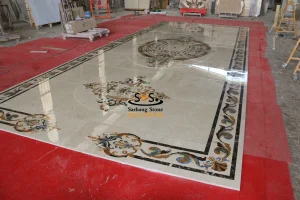
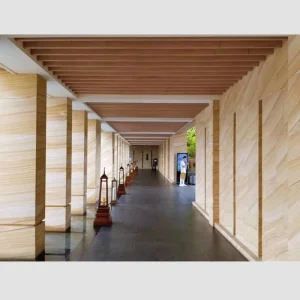
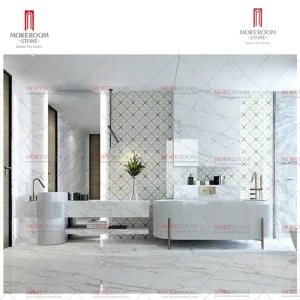
Analyzing the transition from regional aggregate cast-in-place installations to precision-engineered precast cladding and flooring solutions.
Terrazzo has evolved from a mid-century Italian craftsmanship tradition into a crucial materials segment for sustainable architecture. Once relying solely on labor-intensive, cast-in-place methods, the contemporary architecture, engineering, and construction (AEC) industries now lean heavily toward precast terrazzo slabs and tiles. The global market size for terrazzo surfaces has witnessed a significant compound annual growth rate (CAGR), propelled by structural trends in sustainable construction certifications, including USGBC LEED v4, BREEAM, and WELL building standards.
Global procurement teams prioritize precast inorganic terrazzo due to its performance consistency. Under high-temperature vacuum press manufacturing, raw materials achieve density parameters that eliminate natural voids. Consequently, the resulting engineered stone excels in compressive strength, low moisture absorption, and thermal shock resistance. This has transformed terrazzo from simple flooring into structural wall cladding, custom furniture, stair treads, and heavy-duty industrial pavements.
An objective, performance-focused evaluation of global industry leaders shaping architectural surfaces.
Based in the ceramic and stone capital of Foshan, China. Aura Stone leads in combining high-throughput automated Italian production technology with premium raw material sourcing. Known for supplying custom precast inorganic terrazzo to large-scale municipal networks in Europe and Asia.
An Italian powerhouse focusing entirely on marble-cement terrazzo. Renowned for architectural-grade blocks, slabs, and custom shapes. They have set European design benchmarks by utilizing natural pigments and high-performance Portland cements.
A pioneer in both quartz-bound engineered stone and resin-bonded terrazzo. Based in Italy, they offer high aesthetic consistency, which has made them a standard choice for global retail franchise fit-outs and luxury hotel chains.
The premier distributor and fabricator in the North American market. Specialized in epoxy terrazzo aggregates, divider strips, and chemical sealers. They provide extensive technical support for local installers across the United States.
Creators of the TERRAZZCO Brand. They offer complete epoxy systems, precast tiles, and bespoke aggregates. They are noted for their supply chain integration and custom sample generation for architectural specifications.
Traditionally a luxury glass mosaic manufacturer, Bisazza has expanded its portfolio to include premium, design-forward terrazzo collections. Their focus is on striking aesthetic patterns designed by leading international architects.
Established in 2005. Integrating quarry resources, intelligent manufacturing, and global engineering solutions.
Foshan Aura Stone Co., Ltd. was established in Foshan, China, in 2005. Over the past 20 years, we have grown into a leading supplier and exporter of high-quality building materials and stone products, serving customers in more than 150 countries worldwide.
With two decades of experience, we have accumulated rich industry knowledge and extensive global customer resources. In recent years, the company has focused on upgrading its core competitiveness, investing in mining resource development, intelligent production technologies, and the processing of finished products. Transitioning from a trade-oriented company to a comprehensive import and export enterprise, we now offer integrated solutions that meet the highest international standards.
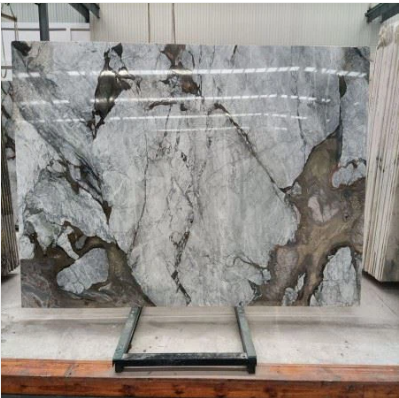
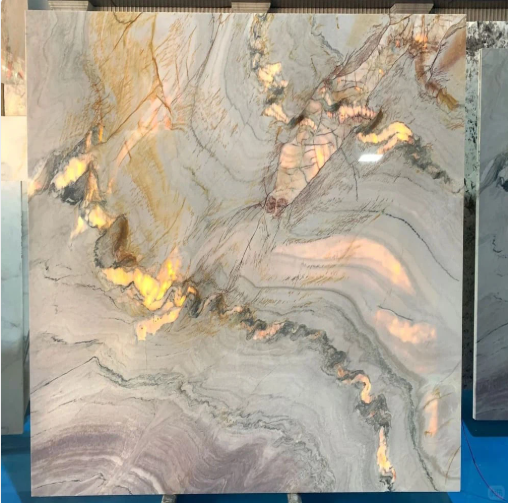
Our products have been applied in numerous significant projects worldwide, including prestigious government and commercial developments, such as large-scale urban renovation projects in Switzerland, national cemetery constructions in Russia, subway stations in the Netherlands, and many high-end hotel and villa projects through long-term partnerships with distributors and construction supply chains.
In the past five years, with rising quality and service expectations in the domestic market, Foshan Aura Stone has expanded its cooperation with premium hotels and major engineering companies, providing export-quality products and services domestically. This strategy has allowed us to combine global experience with local excellence, ensuring that each project is executed to the highest standards.
We adhere to the corporate values of responsibility, progress, gratitude, and happiness, with a mission to cultivate professional expertise within our team. Our vision is to make architecture worldwide more beautiful and sustainable. Through dedicated service and collaborative innovation, we have earned the trust and recognition of customers across the globe, establishing long-term, win-win partnerships.
Foshan Aura Stone Co., Ltd. continues to advance in technology, design, and global partnerships, committed to creating a lasting impact on the construction and stone industry worldwide.
Unveiling the technological upgrades and supply chain density that drive cost-performance ratios.
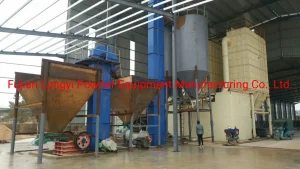
Contemporary Chinese terrazzo factories utilize high-density block casting lines that replicate natural geological pressure. Slabs are not individually poured; instead, large blocks (typically 3000x1200x900mm) are cast under vacuum conditions with a vibration force reaching several hundred tons. This process expels microscopic air pockets, resulting in a product with a density greater than 2.5 g/cm³. The block is subsequently cured and sliced using multi-blade diamond gang saws, ensuring uniform slab thickness with minimal tolerance.
Foshan’s industrial cluster sits at the intersection of global aggregate logistics. Factories source high-purity marble chips, calcined quartz, river pebbles, and recycled glass aggregates at scale. This allows manufacturers to offer customized colors with minimal lead times. The proximity to high-capacity white cement production facilities further reduces inbound logistics costs, a saving passed directly to commercial buyers.
| Performance Metric | Traditional Cast-In-Place | Aura Precast Inorganic Terrazzo | Epoxy-Bound Resin Terrazzo |
|---|---|---|---|
| Compressive Strength | > 50 MPa | > 90 MPa | > 110 MPa |
| Water Absorption | < 3.0% | < 0.5% (Nano treated) | < 0.1% |
| Fire Classification | Class A1 (Non-combustible) | Class A1 (Non-combustible) | Class B (Combustible resins) |
| UV & Weather Resistance | Good | Excellent (Non-fading) | Poor (Subject to yellowing) |
| VOC Emissions | Zero VOC | Zero VOC / GreenGuard Gold | Varies depending on binder type |
For municipal infrastructures, such as subway systems, transit hubs, and commercial complexes, delivery speed determines project viability. Foshan Aura Stone's continuous polishing lines run on automated, multi-head processes. This allows for a daily production capacity exceeding 5,000 square meters. Such volume enables developers to complete large floor plates in weeks rather than months, eliminating the curing delays associated with cast-in-place installations.
Deploying precast stone surfaces across demanding modern built environments.
Subway hubs, airports, and train terminal concourses experience heavy foot traffic and continuous vibration. Using Class A1 fire-rated precast terrazzo provides durability and ensures safety. High-density tiles with slip ratings of R9 or R10 help reduce maintenance costs in high-traffic public spaces.
Unlike epoxy terrazzo, which degrades under direct solar ultraviolet rays, inorganic cementitious terrazzo does not yellow or lose structural integrity. Utilizing undercut anchor systems, precast terrazzo slabs are easily installed as ventilated rainscreen facades, providing thermal mass and modern aesthetics.
Contemporary retail spaces demand brand-specific color coordination. Custom-mixed precast slabs allow designers to incorporate recycled glass, mother-of-pearl, and semi-precious stone chips. This creates a distinctive surface design for vanity tops, lobby floors, and focal feature walls.
Essential checks and technical parameters for procurement officers and stone estimators.
Procuring stone materials from overseas requires strict verification. Buyers should request certified test reports, including ASTM (American Society for Testing and Materials) and EN (European Standards) tests. Essential parameters include:
High-quality terrazzo relies on an optimal ratio of fine filler particles to large aggregate chips. Inadequately cured concrete matrices often result in hairline fractures post-installation. Slabs must undergo standard moist-curing chambers for a minimum of 28 days (or accelerated autoclave curing) to fully hydrate the cement binders before calibration and final polishing.
Technical answers to common questions about precast inorganic terrazzo products.
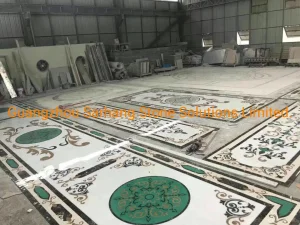
Explore our broader range of natural stone claddings, waterjet medallions, and building mineral materials.
 Aura Stone