Semi-precious stone brings color, depth, and natural movement to interior surfaces. Unlike factory-made tiles, each slab can contain different veins, crystal clusters, shadows, and transparent areas. These details make direct square-foot pricing difficult. A small sample may not represent the full stone. The finished surface can also change after cutting, polishing, and edge fabrication.
This guide explores the practical question: Why is semi-precious stone sold by the slab and not square foot? The answer involves more than surface area. Suppliers must account for the complete raw piece, usable sections, thickness, reinforcement, finishing, and possible cutting waste. A slab may measure ten square feet, yet only eight square feet may suit a visible countertop design. The remaining material might not match the project’s pattern or color direction.
Real project experience shows why viewing the actual slab matters. A designer may mark a sink opening across a dramatic quartz crystal, while another section remains unused. That visual decision affects value. Fabricators also inspect slabs for natural fractures, resin support, and handling risks before cutting. Prices therefore often reflect the individual slab’s quality and character, not merely its dimensions.
The process is not always neat. Some suppliers may quote by square foot for convenience, while others use slab pricing for better transparency. Buyers should confirm whether delivery, cutting, polishing, backing, installation, and waste are included. Ask for exact slab measurements and photographs. Request a written quotation. Small details matter. This approach helps homeowners, designers, and contractors compare offers fairly and avoid unexpected costs.
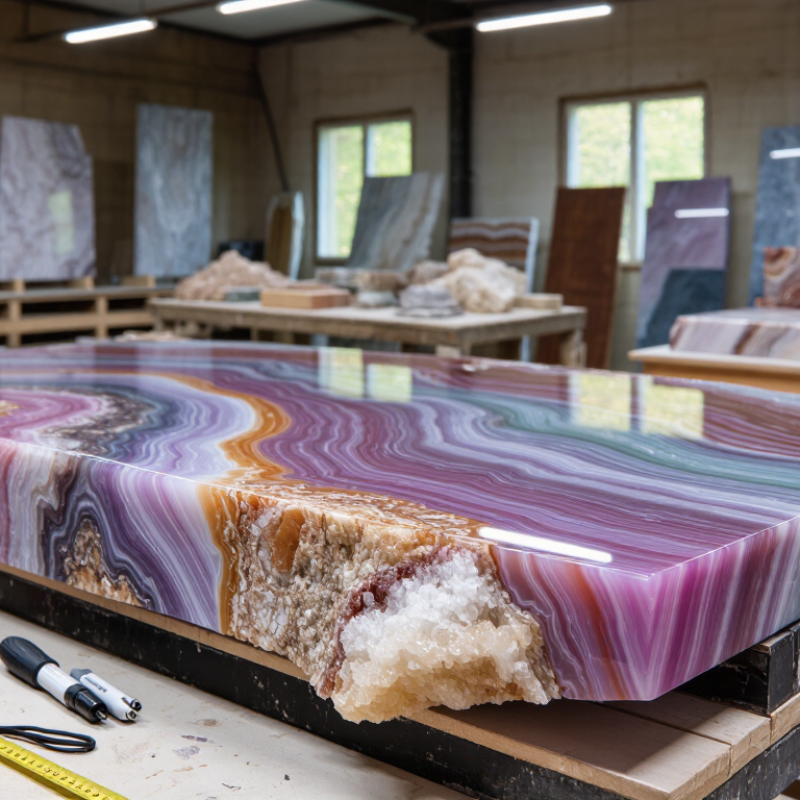
“Sold by slab” means you purchase the complete semi-precious stone panel, not a measured square-foot section. The supplier usually lists slab length, width, thickness, finish, and lot number. Each panel is different. Natural crystal clusters, color bands, and small fissures make standard square-foot pricing difficult. A full slab may measure about 120 by 65 inches, but actual dimensions vary by material and extraction.
The Natural Stone Institute’s Dimension Stone Design Manual recommends checking slab thickness, tolerances, finish, and installation conditions before fabrication. These details affect usable yield. A fabricator may need to reserve extra material around sink cutouts, edges, and book-matched patterns. That waste is real. It is not always obvious in a showroom.
The 2024 U.S. Houzz Kitchen Trends Study reports that many renovated kitchens receive upgraded countertops, showing continued demand for premium surface materials. However, public market reports rarely separate semi-precious stone from broader natural-stone categories. That limitation matters. A price quoted per square foot may exclude polishing, cutting, reinforcement, transport, or unusable sections. Ask for the slab’s exact dimensions and net usable area. Request photographs under neutral lighting. Then compare total project cost, not only the advertised unit rate. Mistakes happen. Even experienced buyers can underestimate pattern loss.
Choose a full slab for islands, wall panels, or waterfall edges. Continuous veining matters here. It offers better control over color, grain direction, and seam placement. However, you pay for unused areas too. That leftover corner still affects the budget.
Square-foot pricing suits backsplashes, vanity tops, shelves, and small repairs. It helps control the initial purchase amount. This method works when strict pattern matching is unnecessary. Ask whether the measurement includes waste and cutting losses.
The listed rate may exclude fabrication, edging, sealing, delivery, and installation. Sink cutouts can add another charge. A low unit price may not show the complete cost. Request a detailed written breakdown before approving the project.
Compare the same thickness, finish, quantity, and service scope. A slab measuring 120 by 75 inches covers 62.5 square feet before cutting. A 15% cutting loss reduces the usable area. The effective price may rise sharply. Simple multiplication is not enough.
Inspect the actual stone whenever possible. Look for fissures, color shifts, unusual grain, and surface variation. Photographs can hide important details. Check thickness, finish, lot consistency, and replacement availability in writing. Small differences can become obvious after installation.
Seam planning helps fabricators position joints and protect visual continuity. It is especially important for large counters and bookmatched surfaces. A poor cut plan can waste valuable material. I once underestimated waste on an irregular counter. That error was avoidable.
Usable yield depends on the layout, cutouts, edges, and visible defects. A 120-by-75-inch slab has 62.5 square feet before cutting. If the project needs 48 square feet, the unused area may still be costly. Defects can reduce the practical yield further. Estimates are never perfect.
The quote should separate material, waste, fabrication, labor, transport, taxes, and installation. Confirm whether polishing and cutouts are included. Ask how the area was measured. Net coverage and purchased coverage are not identical. Review the cut plan carefully.
Semi-precious stone may be sold by the slab rather than by square foot because each slab is a unique natural piece with its own color, pattern, thickness, edges, and usable area. The question “Why is semi-precious stone sold by the slab and not square foot” is best answered by considering production, rarity, and waste. Slab pricing gives buyers control over the exact material they receive, while square-foot pricing focuses on the amount needed for a finished surface.
Square-foot quotes can be useful for estimating countertops, wall panels, furniture, or decorative installations, but they may not include fabrication, cutting, polishing, transport, matching, or unused material. Slab-based costs depend on stone quality, size, thickness, design consistency, availability, and processing requirements. Buyers should compare both methods by checking the total slab price, usable square footage, expected waste, fabrication fees, and installation needs. This approach helps match the purchasing method to the project’s design, budget, and material requirements.

 Aura Stone